
Your Assets Are Talking. Are You Listening?
For many businesses, asset management is treated like housekeeping. You log the asset, schedule the maintenance and tick the box when the job is done. On paper, that looks like control; everything is recorded, everything is accounted for, and there is a quiet confidence that the job has been handled.
But that version of control is often an illusion.
Assets do not just sit there waiting to be maintained; they are part of how work actually happens. They appear in incident investigations, accumulate defects, generate actions, and over time build a history that tells a much bigger story than a maintenance schedule ever could.
Every fault, delay, repair, or workaround is a signal. Not just about the condition of the asset, but about the environment people are working in and the decisions they are being forced to make. When you follow that trail properly, patterns start to emerge.
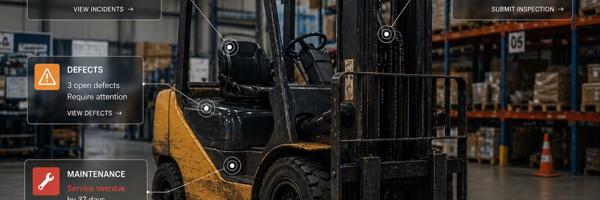
The same forklift appears in multiple near-miss reports. A piece of equipment keeps generating defects that never seem to be fully resolved. Maintenance slips just enough to become normal. Individually, each issue looks minor but together? Together they reveal operational risk.
None of this is random. It is your operation talking back to you, quietly and consistently, whether you are listening or not. The problem is rarely that the information doesn’t exist. In most systems, it is already there. Incidents are recorded, maintenance is logged, assets are listed and linked. But too often, these are treated as separate threads rather than part of the same story.
So while the connections technically exist, they are not always visible in a way that drives action. And if something is not visible, it does not get prioritised. It gets missed and that is where things start to shift.
When you can clearly see how an asset connects to incidents, maintenance, defects, and actions, it stops being just another item in a register and becomes something you can genuinely manage.
You begin to see when an asset is not just being maintained, but is actively contributing to risk. You can spot repeat issues before they escalate, prioritise the right work, and make decisions based on what is actually happening in your business, not just what is next on a checklist.
This has a direct impact on your people as well.
In many workplaces, employees are quietly compensating for assets that are not quite right. They adjust how they work, find ways around problems, and “make do” because the job still needs to get done and KPI’s need to be reached. Over time, those workarounds become normal, and that is where risk embeds itself. A system that makes asset-related issues visible early removes some of that pressure and it supports better decisions before someone is forced to make a bad one.
Engage has always allowed assets to be linked to incident investigations, maintenance, and other parts of the system. That capability is not new. What we have focused on in this latest update is making those connections easier to see, navigate, and use in practice. The information was already there, but like in many systems, it was not always front of mind. With improved layout and visibility, it is now much easier to understand the full picture of an asset at a glance and act on what you are seeing.
Because the reality is that most incidents do not come out of nowhere. They build over time through signals that were always present. The difference between reacting late and acting early often comes down to whether those signals are visible and understood.
So the real question is not whether your assets are being maintained. It is whether your system is helping you understand what those assets are telling you. And if your asset register is only recording what you own, rather than helping you understand operational risk, it may be time to ask whether your system is doing enough.
For more information on how the Engage safety platform can help you, contact us today.